Ejection Stress Modeling to Support Formulation and Process Design in Tablet Manufacturing
Background
In oral solid dosage (OSD) manufacturing, tablet ejection is the final step of the compaction cycle. After compression, the lower punch pushes the compacted tablet out of the die while the upper punch is retracted. Although often treated as a routine mechanical action, tablet ejection plays a critical role in both product quality and long-term equipment performance.
Excessive resistance during ejection can result in mechanical stress within the tablet structure, increasing the risk of defects such as capping, lamination, or edge chipping. At the same time, high ejection forces accelerate wear of punches and dies, potentially leading to increased maintenance requirements and reduced tooling lifetime. Understanding and controlling the factors that drive ejection behavior is therefore an important aspect of robust formulation and process design.
From Ejection Force to Ejection Stress
The force required to eject a tablet from the die is influenced by multiple factors, including:
- Compaction pressure and dwell time
- Compaction speed
- Die-wall friction
- Material properties of the API and excipients
- Lubricant type and concentration
However, absolute ejection force values depend strongly on tablet size. Larger tablets inherently exhibit higher forces simply due to their increased contact area with the die wall. This makes direct comparison between formulations or tablet geometries difficult.
To address this limitation, ejection stress is commonly used as a normalized metric. Ejection stress is calculated by dividing the peak ejection force by the tablet’s contact area with the die wall and is typically expressed in MPa. This normalization allows meaningful comparison across tablet sizes and geometries.
From a practical perspective, maintaining ejection stress below approximately 3 MPa is often recommended. Staying within this range helps reduce the likelihood of tablet defects and limits mechanical wear on tooling, although the precise threshold may vary depending on equipment design and formulation sensitivity.
Modeling Approach: Predicting Ejection Stress from Material Properties
Rather than relying solely on experimental compression trials, predictive process models were used to simulate ejection stress as a function of formulation composition and compaction conditions. These models link:
- Mechanical properties of the API and excipients
- Deformation behavior (plastic vs. brittle)
- Sensitivity to lubrication
- Process parameters such as compaction pressure and speed
By incorporating these inputs, the models estimate die-wall friction and the resulting ejection stress under defined operating conditions. This enables systematic evaluation of “virtual formulations” across a range of compaction pressures and speeds, before any material is physically compressed.
Such an approach is particularly useful in early development, where material availability may be limited and the formulation design space is still being explored.
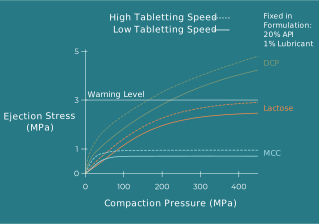
Case Example: Influence of Filler Choice and Compaction Speed
In this example, a formulation containing:
- 20% API
- 1% lubricant
was evaluated using three commonly used fillers:
- Lactose
- Dicalcium phosphate (DCP)
- Microcrystalline cellulose (MCC)
Simulations were performed at low and intermediate compaction speeds across the operational pressure range of the tablet press.
Effect of Filler Type
The predicted ejection stresses showed clear differences between the fillers:
- Microcrystalline cellulose (MCC) consistently produced lower ejection stresses. This behavior can be attributed to its predominantly plastic deformation mechanism, which promotes better stress redistribution during compaction. MCC also tends to respond well to lubrication, further reducing die-wall friction during ejection.
- Lactose exhibited intermediate ejection stress values. As a more brittle material, lactose fragments during compaction, leading to increased interparticle bonding and higher die-wall friction compared to MCC.
- Dicalcium phosphate (DCP) showed the highest ejection stresses across the pressure range. Its brittle, non-plastic nature and relatively low lubricant sensitivity contribute to increased friction at the die wall, making it more prone to elevated ejection stress.
Effect of Compaction Speed
The simulations also highlighted the influence of compaction speed. Increasing speed led to higher predicted ejection stresses across all formulations. This effect is commonly associated with reduced dwell time and less effective lubricant redistribution at higher speeds, resulting in increased die-wall friction.
Supporting Formulation Decisions
By combining these ejection stress predictions with other modeled or measured critical quality attributes—such as tablet strength, porosity, or weight variability—it becomes possible to compare formulation options in a structured and quantitative manner.
In this case, the simulations helped:
- Identify fillers more likely to remain within acceptable ejection stress limits
- Highlight increased risk associated with brittle excipients under higher-speed operation
- Inform decisions on formulation composition and operating conditions before experimental trials
Conclusion
This case study demonstrates how predictive modeling of ejection stress can support formulation and process development in OSD manufacturing. By translating material properties and compaction parameters into a normalized, process-relevant metric, models provide early insight into potential risks related to tablet integrity and tooling wear.
Used alongside other modeling and experimental tools, ejection stress simulations enable more informed decision-making, reduce reliance on trial-and-error experimentation, and help define robust operating windows for both formulation and process design.