Using Formulation Flow Modeling to Assess Glidant Addition for Maximum Processable API Content in Direct Compression
Background
Direct compression remains one of the most attractive tablet manufacturing routes due to its simplicity, low cost, and limited number of processing steps. However, its applicability is often constrained by the flow properties of the formulation, particularly when high API loadings are required.
A growing proportion of new APIs exhibit particle sizes below 80 µm. At this scale, particles tend to be highly cohesive due to increased surface area and inter-particle forces such as van der Waals interactions. As a result, these APIs are prone to agglomeration and typically show poor flowability, which directly impacts die filling and tablet weight uniformity.
To maximize API content while maintaining acceptable flow behavior, careful selection of fillers is essential. In many cases, formulation flow models can be used to identify excipient combinations that compensate for the poor flow of the API. However, even with optimized filler selection, there are situations where the desired API loading remains unachievable. In such cases, the addition of a glidant becomes a potential strategy.
Role of Glidants in Improving Powder Flow
Glidants are commonly added in small quantities to improve powder flow by reducing inter-particle cohesion. One widely used approach is dry coating with nano-sized silicon dioxide, such as colloidal silica. These fine particles adhere to the surface of larger API particles, reducing effective contact area and lowering cohesive forces.
The effectiveness of a glidant depends on achieving sufficient surface coverage of the API particles. A commonly used concept to estimate the required amount of silica is surface area coverage (SAC). SAC represents the theoretical quantity of glidant needed to form a monolayer over the API surface and is calculated based on:
- The API’s Sauter mean diameter
- The true density of the API
While SAC provides a useful first estimate, actual flow improvement is influenced by additional factors, including:
- API particle morphology and surface roughness
- Particle size distribution
- Baseline flow properties of the API (e.g., ring shear test results)
As a result, determining whether glidant addition will meaningfully expand the formulation design space is not straightforward based on SAC calculations alone.
Modeling Approach: Simulating API–Glidant–Excipient Systems
To address this complexity, formulation flow models were extended to explicitly simulate the behavior of API–glidant mixtures combined with common excipients. The modeling framework accounts for:
- Changes in API cohesion as a function of glidant surface coverage
- Interactions between the coated API and filler particles
- Resulting effects on powder flow and die filling
Virtual formulations were generated for systems with and without glidant, including scenarios corresponding to 100% SAC. This made it possible to evaluate the impact of glidant addition across a wide composition range without extensive experimental screening.
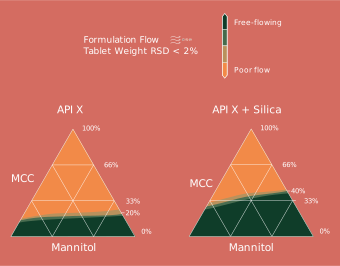
Case Example: Mapping Processable Formulations Using Ternary Diagrams
In this case study, blends consisting of:
- A cohesive API
- Mannitol
- Microcrystalline cellulose (MCC)
were evaluated using ternary composition diagrams. Each point within the triangular diagram represents a unique formulation, defined by the relative proportions of the three components.
For each virtual formulation, the model predicted tablet weight variability on a single-punch tablet press. Regions of the diagram corresponding to less than 2% tablet weight %RSD were identified as acceptable in terms of flow and die filling performance.
Without Glidant
In the absence of a glidant, the model predicted acceptable tablet weight consistency only at relatively low API contents. Processable formulations were largely confined to API concentrations below approximately 20%, beyond which increasing cohesion led to excessive weight variability.
With Glidant at 100% SAC
When a glidant was added at a level corresponding to 100% surface area coverage, the predicted flow behavior improved substantially. The acceptable region within the ternary diagram expanded, allowing formulations with API contents exceeding 35% to be processed while maintaining tablet weight variability below the defined threshold.
Insights for Formulation Development
This modeling exercise provided several actionable insights:
- Glidant addition can significantly extend the feasible API loading range in direct compression
- The benefit of glidant addition is formulation-specific and depends on both API properties and excipient selection
- Ternary diagrams offer an intuitive way to visualize the formulation design space and identify robust composition regions
By evaluating these effects virtually, formulation scientists can make informed decisions about whether glidant addition is likely to be effective before committing to experimental trials.
Conclusion
This case study demonstrates how predictive formulation flow modeling can support the rational use of glidants to increase maximum processable API content in direct compression. By integrating API material properties, glidant surface coverage concepts, and excipient interactions, models provide early insight into the achievable formulation space.
Such an approach reduces reliance on trial-and-error experimentation, helps prioritize promising formulation strategies, and supports data-driven decisions when balancing high drug loading with robust manufacturability.