Using Predictive Flow Modeling
to Support Lubricant Application Method Decision
Background
Lubrication strategy plays a critical role in tablet manufacturing, influencing not only tooling performance but also powder flow, content uniformity, and final tablet properties. Traditionally, lubricants such as magnesium stearate are incorporated internally by blending them into the formulation. This approach improves powder flow and reduces die-wall friction, but it can also negatively affect tablet strength, dissolution behavior, and sensitivity to over-lubrication.
In response to these challenges, external lubrication has gained increasing attention. By applying the lubricant directly to the tooling rather than blending it into the powder, its impact on tablet properties can be minimized. However, this strategy removes the beneficial flow-enhancing effect of internal lubricants. As a result, ensuring consistent powder flow into the die becomes more challenging, particularly for formulations containing poorly flowing active pharmaceutical ingredients (APIs).
This case study illustrates how predictive process models can be used to evaluate and manage these challenges early in development, supporting formulation and process decisions before extensive experimental work is undertaken.
The Challenge: Powder Flow Without Internal Lubrication
In tablet compression, powder flowability directly affects die filling and, consequently, tablet weight variability. Poor flow leads to fluctuations in the mass of powder entering the die, which can result in unacceptable tablet weight variation (expressed as relative standard deviation on weight, %RSD) and downstream quality risks.
When internal lubricants such as magnesium stearate are removed from a formulation, either partially or entirely, the flow behavior of the powder blend becomes increasingly dependent on the intrinsic properties of the API and excipients. This can be especially critical when working with:
- Semi-fine or cohesive API grades
- Spray-dried or low-density excipients
- High drug load formulations
Under these conditions, determining the maximum achievable drug loading while maintaining acceptable flow becomes a non-trivial task. Trial-and-error experimentation could be time-consuming and material-intensive, particularly in early development stages where API availability may be limited.
Modeling Approach: Simulating Flow via Tablet Weight Variability
To address this challenge, advanced process models were used to simulate powder flow behavior in a single-punch tablet press. Rather than relying on empirical flow tests alone, the models predict tablet weight variability (%RSD) as a function of formulation composition and raw material properties.
The modeling framework incorporates:
- Particle and bulk properties of the API and excipients
- The relative contribution of each component to blend flowability
- Die filling dynamics under defined press conditions
By linking material properties to a process-relevant outcome (the relative standard deviation on tablet weight, %RSD), the models provide a practical and interpretable measure of flow performance.
Using this approach, virtual formulations can be generated and evaluated in silico, allowing potential flow limitations to be identified before experimental trials are initiated.
Case Example: Evaluating Drug Loading Limits
In this example, a formulation was considered consisting of:
- A fixed excipient base representing approximately 30% of the total formulation
- A semi-fine API grade
- Spray-dried lactose as the primary filler
Two lubrication scenarios were evaluated:
- No lubricant (representative of external lubrication)
- 1% magnesium stearate added internally
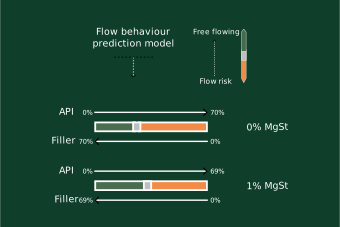
For each scenario, the model predicted tablet weight %RSD as a function of increasing drug loading.
Without internal lubricant, the simulations indicated that acceptable flow behavior, and thus acceptable tablet weight variability, could be maintained up to approximately 26% drug loading. Beyond this point, the increasing contribution of the semi-fine API led to insufficient flow and an unacceptable rise in predicted weight variability.
With 1% magnesium stearate, the predicted flow performance improved. The model indicated that acceptable tablet weight variability could be sustained up to approximately 30% drug loading, reflecting the well-known flow-enhancing effect of magnesium stearate.
Insights and Impact
This modeling exercise provided several valuable insights:
- External lubrication imposes stricter constraints on formulation design, particularly with respect to API particle properties and drug loading
- Even modest levels of internal lubricant can significantly extend the feasible design space for poorly flowing APIs
- Predictive models enable quantitative comparison of formulation scenarios without the need for immediate experimental validation
Crucially, these insights were available early in development, allowing informed decisions to be made regarding:
- Target drug loading
- Lubrication strategy
- Risk associated with external lubrication for a given API grade
Conclusion
This case study highlights the role of predictive process modeling as a decision-support tool in pharmaceutical formulation development. By translating raw material properties into process-relevant outcomes such as tablet weight variability, models enable rational evaluation of formulation strategies under realistic manufacturing constraints.
In contexts where external lubrication is considered to protect tablet performance, such modeling approaches become particularly valuable. They help define the limits of feasible operation, reduce reliance on trial-and-error experimentation, and support data-driven decisions when balancing manufacturability and product quality.