Leveraging Tabletability Predictions to Detect Mechanical Instability at an Early Stage
Background
Mechanical robustness is a fundamental quality attribute of tablets, influencing their ability to withstand handling, packaging, transport, and downstream processing. It also plays an indirect role in drug performance, as tablet integrity affects porosity, disintegration, and ultimately dissolution behavior.
A commonly used measure of mechanical robustness is tensile strength, which describes the stress a tablet can withstand before fracturing. Tensile strength depends on both formulation composition and applied compression force. The relationship between compression pressure and resulting tensile strength is known as tabletability.
During early formulation development, APIs often exhibit suboptimal tabletability, particularly when fine or poorly deformable grades are used. Selecting appropriate excipients, especially fillers with favorable compaction behavior, is therefore critical. However, generating full tabletability profiles experimentally can require substantial material and time, which may be limiting during early development.
Modeling Approach: Predicting Tabletability from Minimal Material Input
Predictive tabletability models were used to estimate tensile strength across a wide range of compression pressures using only small quantities of material. These models integrate:
- Mechanical properties of the API and excipients
- Deformation mechanisms (plastic vs. brittle)
- Lubricant effects on interparticle bonding
Rather than predicting tensile strength at a single compression point, the models reproduce the entire tabletability curve, enabling a more comprehensive assessment of formulation behavior under increasing compaction pressure.
This curve-based approach allows not only the comparison of fillers but also the identification of pressure regions associated with mechanical risk—information that is difficult to obtain from isolated experimental measurements.
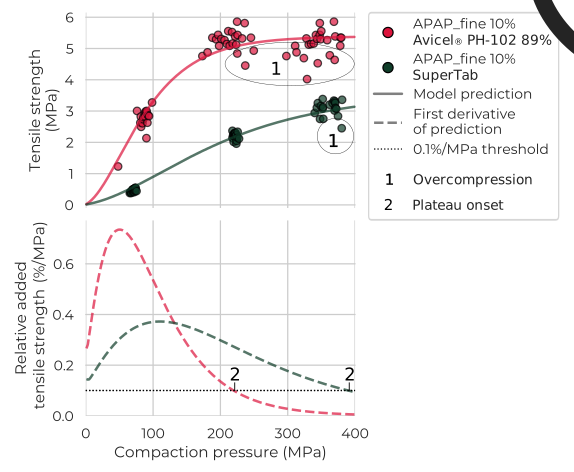
Case Example: Comparing Filler Performance with a Poorly Tabletable API
In this case study, the tabletability of formulations containing the same API, paracetamol (APAP) fine, was evaluated in combination with different fillers. The formulations consisted of:
- 10% API (APAP fine)
- Either microcrystalline cellulose (MCC) or lactose as filler
- 1% magnesium stearate as lubricant
Predicted tensile strength values were generated across a range of compression pressures to construct full tabletability curves for each formulation.
Key Regions of the Tabletability Curve
The predicted curves enabled the identification of two critical regions that are highly relevant for formulation and process design.
1. Overcompression Region
At high compression pressures, the tabletability curves showed a leveling off or even a decrease in tensile strength. This region is associated with overcompression, where additional pressure no longer improves mechanical strength and may instead introduce structural weaknesses.
Mechanistically, overcompression is linked to increased storage of elastic energy within the compact during compression. Upon decompression, this stored energy is released. If the resulting internal stresses exceed the strength of particle-particle bonds, microcracks can form within the tablet structure.
These microcracks are not always immediately visible but represent early indicators of mechanical instability. Experimental observations often show increased variability in tensile strength in this region, reflecting the onset of structural damage. If unaddressed, such microstructural defects can evolve into macroscopic issues such as capping or lamination during scale-up or high-speed production.
2. Plateau Onset
The plateau onset corresponds to the compression pressure at which the incremental gain in tensile strength becomes minimal. This point can be identified quantitatively by examining the first derivative of the tabletability curve and detecting when it falls below a defined threshold.
From a material science perspective, the plateau onset indicates that most accessible bonding sites between particles have been activated. Beyond this pressure, further densification yields diminishing returns in terms of tablet strength, while simultaneously increasing the risk of elastic stress accumulation.
Importantly, the onset of the tensile strength plateau aligns closely with the beginning of the overcompression region. This makes it a particularly useful marker for defining an upper safe limit for compression pressure.
Implications for Formulation Screening and Design
In this example, the predicted tabletability curves clearly differentiated the behavior of MCC- and lactose-based formulations when combined with APAP fine. The ability to identify both the plateau onset and the overcompression region directly from model predictions provided several advantages:
- Early detection of compression pressures associated with mechanical instability
- Quantitative comparison of fillers in terms of their ability to compensate for poor API tabletability
- Support for defining robust compression windows without extensive experimental trials
By screening formulations at this level, development teams can prioritize candidates with a broader safe operating range and lower risk of downstream mechanical defects.
Conclusion
This case study illustrates how predictive tabletability modeling can be used to detect early signs of mechanical instability in tablet formulations. By reproducing the full tensile strength–pressure relationship, models enable the identification of critical regions such as the plateau onset and overcompression zone, which are key indicators of structural risk.
Incorporating tabletability predictions into early formulation development supports more informed filler selection, reduces reliance on trial-and-error experimentation, and provides a quantitative basis for large-scale formulation screening and process design.