Transfer modelling
When exploring a processing route, it is crucial to thoroughly investigate the processability of materials and any variations that may occur across different scales or types of equipment. This investigation is not merely a formality; it plays a significant role in ensuring that the chosen processing method will yield the desired product quality and performance. Predictive modeling emerges as a powerful tool in this context, allowing for a comprehensive and rapid assessment of various possibilities and potential pitfalls associated with different processing scenarios. By employing predictive modeling techniques, one can efficiently navigate through the complexities of material behavior and processing conditions.
In particular, transfer modeling stands out as an invaluable approach in this regard. It enables researchers and engineers to gain insights into material or blend-specific phenomena and their interactions with processing parameters through experiments conducted on small-scale devices. The knowledge acquired from these small-scale studies can then be used (with the appropriate additional training) to predict how these materials will behave in larger-scale equipment, where the quality of the final product is often dictated by similar mechanistic behaviors. This transferability is essential, as it allows for the optimization of processes without the need for an equally extensive data collection on larger systems, which would be quite impractical.
The foundational models developed by Elegent provide an excellent starting point for embarking on transfer modeling efforts. These models have been meticulously crafted to capture the intricate interactions of powders across a wide range of materials, focusing on critical factors such as compression behavior and flowability. Capturing the underlying structures of these phenomena is key, as provides a solid base for projection to similar mechanisms occurring in larger-scale devices through transfer modeling. On this scale, data collection can be fraught with challenges related to cumbersome equipment setup and availability of materials and equipment.
Furthermore, it is important to recognize that additional influential process variables may exist that only manifest their effects in larger-scale equipment. These variables can be systematically included through the transfer modeling process to enhance the accuracy and reliability of predictions. Therefore, the most effective strategy for developing models of powder processing devices across various scales is to leverage the robust core of Elegent's models as a foundation. By doing so, one can create a comprehensive modeling framework that not only addresses the complexities of powder processing but also facilitates the successful scaling up of processes from small to large equipment.
Below, a schematic illustration is given for this concept applied to direct compression.
You can find the more detailed version of the same case study in our poster contribution to the 6th APV Continuous Manufacturing conference, available for download at the bottom of this page.
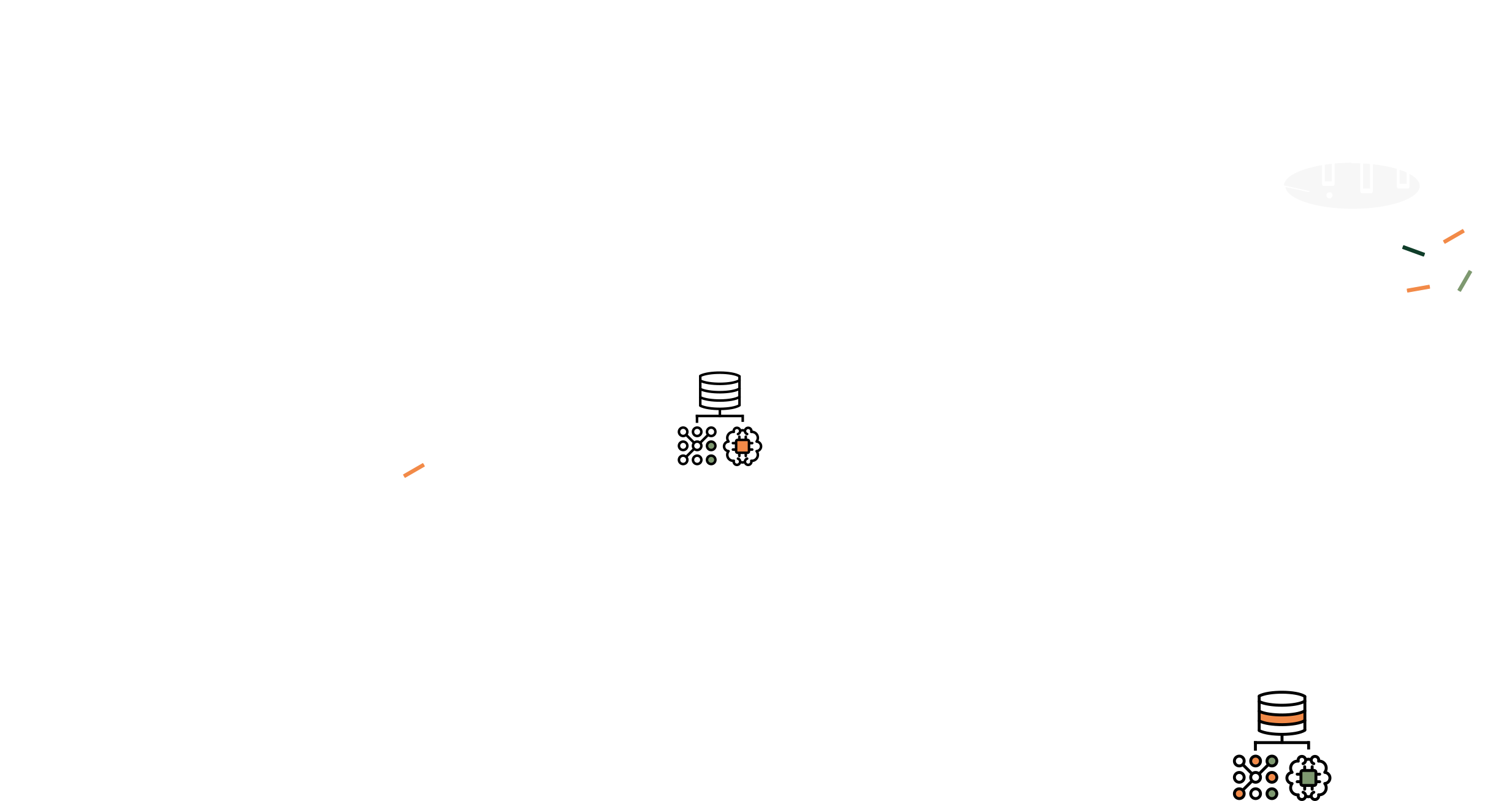
Thanks to the small-scale model that captures interactions between various powders relevant to the industry, a data collection of only the fraction of the size of the small-scale set was needed on the large-scale rotative press in order to build a predictive model for that scale as well.
For formulation flow, for example, predictions can then be made for both scales, even including process influences that were not present on the single-punch compaction simulator.